
Monday, 26 March 2012
Just checking out the blog headers.....
To put an image from your film or your poster on the top of your blog - go to design (top right) and click on edit in the header section. You can add your image there. First you will need to design your image and get it to the right size in PhotoShop. I did 980 pixels width by 200 length for this one.

Question 1a
In class today we looked at a sample answer for the question:
Describe how you used conventions of real media products for your own media production and evaluate how this skill contributed to the development of your work. Refer to a range of examples in your answer to show how these skills developed over time. [25]
Candidates will need to refer to their work for the Foundation Portfolio and Advanced Portfolio. Additionally, they may make reference to other media production work but this is strictly optional.
Now it's your turn to answer this question. You have 30 minutes. Starting - NOW.
Tuesday, 20 March 2012
Homework/Prep task for next lesson - IMPORTANT
In Monday's lesson we were working on how to approach the essay question for Section A: Question 1a. We focused on skills development from AS and A2, looking at RESEARCH AND PLANNING skills and then skills in the use of DIGITAL TECHNOLOGY. For next lesson, you have been asked to meticulously prepare an essay plan to answer the following question:
Describe how you developed post-production skills and evaluate how these skills contributed to creative products. Refer to a range of examples in your answer to show how these skills developed over time. [/25]
You must use the following formula:
Introduction:
- what you did at AS and A2
- comment on opportunity for skills development
- Which specific examples you will refer to in your essay (there should be 4)
Paragraphs 1-4:
- Statement about specific skill i.e. Editing in Photoshop
- Example of work from AS + Example of work from A2
- Evaluate your skills development
- How has this enabled you to be more creative?
Conclusion:
- Comment on your level of skill now and the difference that will make to future projects.
- Comment on any areas for further development and how this would enable you to be more creative.
Monday, 12 March 2012
THIS IS WHAT YOUR BLOGS SHOULD LOOK LIKE:
AS: http://cmdiplomayasmin.blogspot.com/
A2: http://latymermusicvideo2011group6.blogspot.com/
Just look at the creativity and quality!!!!! Look at the final work!!!!!! Where does yours stand in comparison?
You know you're as good as these students - so prove it to the examiner.
A2: http://latymermusicvideo2011group6.blogspot.com/
Just look at the creativity and quality!!!!! Look at the final work!!!!!! Where does yours stand in comparison?
You know you're as good as these students - so prove it to the examiner.
Saturday, 10 March 2012
Final Week of Collective Identity
This week will be our last lessons on the IDENTITY topic until we get to the revision sessions. Get a grip on the theories and study texts now. You will be tested this week!!!!! If you've done your glossary you have nothing to fear......
Tuesday, 6 March 2012
Prep work for exam
you will find the PowerPoints on our media website:
http://www.wix.com/mediadepartment/rwsmedia/a2
http://www.wix.com/mediadepartment/rwsmedia/a2
Tuesday, 31 January 2012
Friday, 27 January 2012
Newspapers reporting the London Riots
Task 1: go to http://www.frontpagestoday.co.uk/2011/08/14/archive.cfm and you should be in August 2011. Study the newspaper coverage from Saturday 6th through to the following weekend. What language do they use to describe a) the protesters b) the events, c) the police d) the government. TIP: Focus on Daily Mail, The Guardian, the Sun.
Task 2: Look at their stories from these days how do they talk about young people?
Task 2: Look at their stories from these days how do they talk about young people?
Tuesday, 24 January 2012
Group task
In your allocated groups, discuss what you found to be key information & use of language in the unfolding of the story on Twitter.
Produce a visual timeline illustrating those key moments - to be formally presented to the class today.
All individual work on timelines for Twitter and TV will be collected at the end of tomorrow's lesson. Please have the work printed, in your course folder and ready for collection. This is an important deadline.
Produce a visual timeline illustrating those key moments - to be formally presented to the class today.
All individual work on timelines for Twitter and TV will be collected at the end of tomorrow's lesson. Please have the work printed, in your course folder and ready for collection. This is an important deadline.
Wednesday, 18 January 2012
How the story unfolded on TV
Task 2: Find TV news coverage for the weekend of the riots from a range of sources. Analyse the clips to find details of images used, people interviewed and language used by the reporters/News anchor. How did the story develop? Are there differences in coverage? Why? You should print screen and reference your sources to use in the exam.
Tuesday, 17 January 2012
Creating a social media timeline
Task 1; Using the resource below, pick out key moments in the unfolding of the "London Riots". Pay careful attention to who is involved in the tweets and the language they use to describe a) the riots b) those involved. This will be a key resource for your exam.

You can access the resource here.....

You can access the resource here.....


Friday, 13 January 2012
13A Homework for Monday 16th
New Topic: Media and Collective Identity
Ask a parent and/or a sibling to write down 5 things to describe you...... for the next lesson.
Ask a parent and/or a sibling to write down 5 things to describe you...... for the next lesson.
Thursday, 29 December 2011
January notices
- 1:1 and small group support for exam is available Tuesday 10th and Wednesday 11th January by appointment only
- (For those not re-sitting) Deadline for all A2 redrafting for this period is Friday 13th January- marking will begin next week - let me know which parts are ready for marking and which you need more time on.
We begin Unit G325 on Monday 16 January
Thursday, 1 December 2011
Instructions for export and upload
Highlight your sequence in the browser.
Right or control click and choose Export, then Using Quicktine Conversion...
Select where you want the file to end up, desktop probably.
Click on Options... button
Go into Settings... in the video portion at top of box.
Compression type - H.264
In data rate section type 5000 into box marked k/bits sec
Click OK
In sound section click on Settings...
In Format drop down menu select AAC
Click OK
Click OK on Movie Settings window
When it's finished upload it to Vimeo.
Right or control click and choose Export, then Using Quicktine Conversion...
Select where you want the file to end up, desktop probably.
Click on Options... button
Go into Settings... in the video portion at top of box.
Compression type - H.264
In data rate section type 5000 into box marked k/bits sec
Click OK
In sound section click on Settings...
In Format drop down menu select AAC
Click OK
Click OK on Movie Settings window
When it's finished upload it to Vimeo.
The Evaluation and FINAL HAND IN
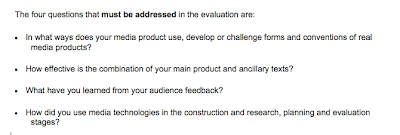
The evaluation is a reflection on your work, with an emphasis on discussion of the key concepts. You are expected to evaluate using the knowledge and terminology you have developed over your A Level studies. Here are the questions you will need to answer in full:
And here is the grading criteria for level 4:

As you can see, it is important that you use creativity in the way you present your evaluation. This means straightforward essays are out of the question. If you are a strong essay writer, you might want to consider using those skills to write a script, and record a director's commentary, answering each of the questions. You don't need to show the film in a linear way either, you can take cuts to illustrate your points.
You can also record a podcast, make a creative prezi or present your answers - but remember you will be marked on your presentation skills.
You have until next Friday to complete the evaluation - FRIDAY 9TH DECEMBER. This is the final hand-in for the whole project so it can be marked in time to allow for final adjustments. It is in your best interests to get everything in on time. My own time for marking is very limited as you know.

And here is the grading criteria for level 4:

As you can see, it is important that you use creativity in the way you present your evaluation. This means straightforward essays are out of the question. If you are a strong essay writer, you might want to consider using those skills to write a script, and record a director's commentary, answering each of the questions. You don't need to show the film in a linear way either, you can take cuts to illustrate your points.
You can also record a podcast, make a creative prezi or present your answers - but remember you will be marked on your presentation skills.
You have until next Friday to complete the evaluation - FRIDAY 9TH DECEMBER. This is the final hand-in for the whole project so it can be marked in time to allow for final adjustments. It is in your best interests to get everything in on time. My own time for marking is very limited as you know.
REMEMBER - IF YOU WANT IT MARKED, PUT IT ON YOUR BLOG!!!
Sunday, 27 November 2011
Deadline for Trailer
The original deadline for the radio trailer was last Friday but as you had an extension for the film, the new deadline is this Wednesday. (There will be no extension because of the strike - the school is open and the media rooms will be open). Last week you were looking at film trailers online and you should also have been searching for radio trailers. Embed at least 2 trailers from your research into your blog and reflect on what you like/dislike about them, what you can use etc. You should be writing up your script for homework on Monday and starting to put it all together in garageband on Tuesday. The trailer should be 30 seconds long.
Friday, 25 November 2011
AS Website after school Tuesday
There will be a session on Tuesday after school. You must attend if you are re-entering.
Tuesday, 15 November 2011
Deadline for A2 Film First Draft: Wednesday 23rd nov
Ensure your film is exported and uploaded to vimeo/youtube then embedded in your blog BY THIS DATE, NOT ON THAT DATE
Tuesday, 14 June 2011
Question 1a overview
- Answer this question using 3 points.
- Each point should provide examples from your own work (as & a2) and link to the question before moving to the next point.
- You must be specific about HOW YOUR SKILLS have developed and how this has made a difference to the final media product.
- Practice coming up with the three points for any possible question in under 3 minutes.
Thursday, 9 June 2011
Monday, 24 January 2011
Wednesday, 19 January 2011
Friday, 14 January 2011
Sample question for section B:
1. How do the contemporary media represent nations, regions and ethnic/ social/ collective groups of people in different ways?
Sample Question for section B
What are the social implications of different media representations of social groups?
Step 1: Key words and what they mean in terms of your case studies
Step 2: List evidence to support argument in support of/against social implications
Step 3: Introduction outlining texts and argument
Monday, 3 January 2011
Tips for Masculinity exam essay:
Introductions:
Strong introductions discuss the problems with trying to connect a media product with notions of male identity. Bring in the argument that the texts could be used to study male identity but they would have to be considered against the historical representation of males in film and magzines and what was happening in other forms of media at the time. Also bring in the argument that both texts were accused of influencing male identity but you must argue that the power of the media on its own over the formation of identity, is more likely to be very limited.
AVOID:
General statements with no evidence or professional opinion to back the statement up i.e. “Lock Stock tells us a massive amount about male identity in the 1990s” Does it really? What exactly? Did men in London generally behave like this at the time? Did Ritchie say he’d had enough of feminism in any of his interviews?
➢ No reference to the question at all
➢ No sense of argument for or against the idea that the film could tell us anything about male identity at the time
➢ No sense of argument for or against the idea that the film could influence male identity at the time
DO:
The best answers keep answering the question with every point they made. Simple. Think about how the point you are making related to the essay question before you start to write the paragraph.
AVOID:
➢ Not working out what the question is asking you to do
➢ Not working out the possible answer to the question
➢ Not planning how you would structure that answer
NOT USING END NOTES TO REFERENCE
CONCLUSIONS:
Nearly always too generalised, not summarising your arguments and no reference to theory. This problem stems from not understanding the question and your argument before you start, When you get to the end you don’t know what you have argued, and neither will the examiner.
Using professional opinion:
The best essays introduce the opinion of the professional at the start of the paragraph, then they explain it in relation to MALE IDENTITY. They then either back this opinion up or challenge it. Again, they finish the paragraph with reference back to the question.
AVOID:
➢ using professional opinion as your own without referencing it
➢ getting the name of the professional wrong or the job of the professional wrong or just not bothering to name them or give them a title at all
➢ not giving the year the comment was published
➢ not stating where the comment was published in the paragraph or in the notes at the end
➢ not using any professional opinion at all because (obviously) your opinion is the only one that counts.
Using theory:
The best essays use the theories to explain how much power the media actually have on the formation of identity.
Laura Mulvey can be used early on in the essay to explain the significance of gender roles in the film. The film represented a male dominated world where women didn’t feature as important characters. In fact, they barely featured at all. The better essays explain how Mulvey argued that cinema was set up for a male audience and that women predominantly featured as passive characters while the men had the important, active roles. They were able to link Mulvey’s ‘Male Gaze’ theory with the male dominated Lock Stock and how it seems to support her theory. They link Mulvey’s theory with the idea that the film was a ‘blacklash against feminism’.
Steve Chibnall’s theory of Gangster Heavy and Gangster Light was used to explain how the film is different in style from traditional gangster films. This was linked with criticisms of Ritchie and the film in the press in which Ritchie was accused of polluting the British film industry.
They used the Media Power debate (Adorno and Fiske) to explain the film in terms of the CULTURE INDUSTRY churning out more of the same to make a profit. How the film was part of the Gangster Cycle (1997-2001) and released in a decade when ‘laddish’ behaviour was evident in many media forms (bring in Loaded and FHM here). Adorno would see the messages about masculinity as a harmful and would argue that male identity was being influenced without them even knowing it. They made the point that Fiske would say the film was a product of its time, reflecting the tastes of the audience at the time. The audience would enjoy it because they could identity with the characters from old gangster films and stories in the press at the time. He would also argue that this is what was influencing Ritchie, along with the films being produced in America, which also seemed to centre on the theme of masculinity. He would argue that the film was not something that the industry was not sending powerful ideological messages, but that the producers were being influenced by what was happening in the world around them.
They also used the NATURE Vs NURTURE debate to explain that while some believe males and females are born with certain gender traits, others believe behaviour is learned from the people and the world around us. They recognised that the media industry is therefore often held responsible for influencing behaviour, especially in vulnerable people who are still forming their identities like children and young men and women. They tied this in with Lock Stock and the claim that the film is responsible for communicating messages about masculinity and for a rise in violent crime.
They used David Gauntlett’s comments on the PROBLEMS with MEDIA EFFECTS theories and tied this in with the point that no matter what the critics write, there is not strong enough evidence to suggest that any media product can affect male behaviour or identity.
BIG problems:
➢ The biggest one was using the theories incorrectly, so it looks as though researching and checking the facts of the theory did not take place. BiG mistake.
➢ Not referencing the theory correctly with details of where it was published and when
➢ Using Nature Vs Nature to talk about characters in the film rather than the effect of the film on male identity
➢ Not using the theories to answer the question, just randomly including them
Strong introductions discuss the problems with trying to connect a media product with notions of male identity. Bring in the argument that the texts could be used to study male identity but they would have to be considered against the historical representation of males in film and magzines and what was happening in other forms of media at the time. Also bring in the argument that both texts were accused of influencing male identity but you must argue that the power of the media on its own over the formation of identity, is more likely to be very limited.
AVOID:
General statements with no evidence or professional opinion to back the statement up i.e. “Lock Stock tells us a massive amount about male identity in the 1990s” Does it really? What exactly? Did men in London generally behave like this at the time? Did Ritchie say he’d had enough of feminism in any of his interviews?
➢ No reference to the question at all
➢ No sense of argument for or against the idea that the film could tell us anything about male identity at the time
➢ No sense of argument for or against the idea that the film could influence male identity at the time
DO:
The best answers keep answering the question with every point they made. Simple. Think about how the point you are making related to the essay question before you start to write the paragraph.
AVOID:
➢ Not working out what the question is asking you to do
➢ Not working out the possible answer to the question
➢ Not planning how you would structure that answer
NOT USING END NOTES TO REFERENCE
CONCLUSIONS:
Nearly always too generalised, not summarising your arguments and no reference to theory. This problem stems from not understanding the question and your argument before you start, When you get to the end you don’t know what you have argued, and neither will the examiner.
Using professional opinion:
The best essays introduce the opinion of the professional at the start of the paragraph, then they explain it in relation to MALE IDENTITY. They then either back this opinion up or challenge it. Again, they finish the paragraph with reference back to the question.
AVOID:
➢ using professional opinion as your own without referencing it
➢ getting the name of the professional wrong or the job of the professional wrong or just not bothering to name them or give them a title at all
➢ not giving the year the comment was published
➢ not stating where the comment was published in the paragraph or in the notes at the end
➢ not using any professional opinion at all because (obviously) your opinion is the only one that counts.
Using theory:
The best essays use the theories to explain how much power the media actually have on the formation of identity.
Laura Mulvey can be used early on in the essay to explain the significance of gender roles in the film. The film represented a male dominated world where women didn’t feature as important characters. In fact, they barely featured at all. The better essays explain how Mulvey argued that cinema was set up for a male audience and that women predominantly featured as passive characters while the men had the important, active roles. They were able to link Mulvey’s ‘Male Gaze’ theory with the male dominated Lock Stock and how it seems to support her theory. They link Mulvey’s theory with the idea that the film was a ‘blacklash against feminism’.
Steve Chibnall’s theory of Gangster Heavy and Gangster Light was used to explain how the film is different in style from traditional gangster films. This was linked with criticisms of Ritchie and the film in the press in which Ritchie was accused of polluting the British film industry.
They used the Media Power debate (Adorno and Fiske) to explain the film in terms of the CULTURE INDUSTRY churning out more of the same to make a profit. How the film was part of the Gangster Cycle (1997-2001) and released in a decade when ‘laddish’ behaviour was evident in many media forms (bring in Loaded and FHM here). Adorno would see the messages about masculinity as a harmful and would argue that male identity was being influenced without them even knowing it. They made the point that Fiske would say the film was a product of its time, reflecting the tastes of the audience at the time. The audience would enjoy it because they could identity with the characters from old gangster films and stories in the press at the time. He would also argue that this is what was influencing Ritchie, along with the films being produced in America, which also seemed to centre on the theme of masculinity. He would argue that the film was not something that the industry was not sending powerful ideological messages, but that the producers were being influenced by what was happening in the world around them.
They also used the NATURE Vs NURTURE debate to explain that while some believe males and females are born with certain gender traits, others believe behaviour is learned from the people and the world around us. They recognised that the media industry is therefore often held responsible for influencing behaviour, especially in vulnerable people who are still forming their identities like children and young men and women. They tied this in with Lock Stock and the claim that the film is responsible for communicating messages about masculinity and for a rise in violent crime.
They used David Gauntlett’s comments on the PROBLEMS with MEDIA EFFECTS theories and tied this in with the point that no matter what the critics write, there is not strong enough evidence to suggest that any media product can affect male behaviour or identity.
BIG problems:
➢ The biggest one was using the theories incorrectly, so it looks as though researching and checking the facts of the theory did not take place. BiG mistake.
➢ Not referencing the theory correctly with details of where it was published and when
➢ Using Nature Vs Nature to talk about characters in the film rather than the effect of the film on male identity
➢ Not using the theories to answer the question, just randomly including them
Sunday, 7 November 2010
Generic feedback for Lock Stock essay
Generic Feedback on Lock Stock essay:
Introductions:
Strong introductions discussed the problems with trying to connect a media product with notions of male identity. They brought in the argument that the film could be used to study male identity in the 1990s but it would have to be considered against the historical representation of males in film and what was happening in other forms of media at the time. They also brought in the argument that the film was accused of influencing male identity but argued that the power of the media over the formation of identity is more likely to be very limited.
BIG problems:
➢ General statements with no evidence or professional opinion to back the statement up i.e. “Lock Stock tells us a massive amount about male identity in the 1990s” Does it really? What exactly? Did men in London generally behave like this at the time? Did Ritchie say he’d had enough of feminism in any of his interviews?
➢ No reference to the question at all
➢ No sense of argument for or against the idea that the film could tell us anything about male identity at the time
➢ No sense of argument for or against the idea that the film could influence male identity at the time
Essay Structure:
The best answers kept answering the question with every point they made. Simple. They thought about how the point they were making related to the essay question before they started to write the paragraph. There weren’t any answers that had an excellent essay structure and that is most probably because all of you started to write before you planned out the argument. Correct me if I’m wrong.
BIG PROBLEMS:
➢ Not working out what the question was asking you to do
➢ Not working out the possible answer to the question
➢ Not planning how you would structure that answer
Introductions:
Strong introductions discussed the problems with trying to connect a media product with notions of male identity. They brought in the argument that the film could be used to study male identity in the 1990s but it would have to be considered against the historical representation of males in film and what was happening in other forms of media at the time. They also brought in the argument that the film was accused of influencing male identity but argued that the power of the media over the formation of identity is more likely to be very limited.
BIG problems:
➢ General statements with no evidence or professional opinion to back the statement up i.e. “Lock Stock tells us a massive amount about male identity in the 1990s” Does it really? What exactly? Did men in London generally behave like this at the time? Did Ritchie say he’d had enough of feminism in any of his interviews?
➢ No reference to the question at all
➢ No sense of argument for or against the idea that the film could tell us anything about male identity at the time
➢ No sense of argument for or against the idea that the film could influence male identity at the time
Essay Structure:
The best answers kept answering the question with every point they made. Simple. They thought about how the point they were making related to the essay question before they started to write the paragraph. There weren’t any answers that had an excellent essay structure and that is most probably because all of you started to write before you planned out the argument. Correct me if I’m wrong.
BIG PROBLEMS:
➢ Not working out what the question was asking you to do
➢ Not working out the possible answer to the question
➢ Not planning how you would structure that answer
NOT USING END NOTES TO REFERENCE
Conclusions:
I can’t remember reading a good one. This is probably because they had all the same problems as the introductions. Too generalised, not summarising your arguments and no reference to theory. This problem stems from not understanding the question and your argument before you start, When you get to the end you don’t know what you have argued, and neither will the examiner.
Using professional opinion:
The best essays introduced the opinion of the professional at the start of the paragraph, then they explained it in relation to MALE IDENTITY. They then either backed this opinion up or challenged it. Again, they finished the paragraph with reference back to what the film tells us about male identity in the 1990s.
BIG PROBLEMS:
➢ used the professional opinion as their own without referencing it
➢ got the name of the professional wrong or the job of the professional wrong or just didn’t bother to name them or give them a title at all
➢ didn’t give the year the comment was published
➢ didn’t name where the comment was published in the paragraph or in the notes at the end
➢ didn’t use any professional opinion at all because (obviously) their opinion is the only one that counts.
Using theory:
The best essays used the theories to explain how much power the media actually have on the formation of identity.
Laura Mulvey was used early on in the essay to explain the significance of gender roles in the film. The film represented a male dominated world where women didn’t feature as important characters. In fact, they barely featured at all. The better essays explained how Mulvey argued that cinema was set up for a male audience and that women predominantly featured as passive characters while the men had the important, active roles. They were able to link Mulvey’s ‘Male Gaze’ theory with the male dominated Lock Stock and how it seems to support her theory. They linked Mulvey’s theory with the idea that the film was a ‘blacklash against feminism’.
Steve Chibnall’s theory of Gangster Heavy and Gangster Light was used to explain how the film is different in style from traditional gangster films. This was linked with criticisms of Ritchie and the film in the press in which Ritchie was accused of polluting the British film industry.
They used the Media Power debate (Adorno and Fiske) to explain the film in terms of the CULTURE INDUSTRY churning out more of the same to make a profit. How the film was part of the Gangster Cycle (1997-2001) and released in a decade when ‘laddish’ behaviour was evident in many media forms (bring in Loaded and FHM here). Adorno would see the messages about masculinity as a harmful and would argue that male identity was being influenced without them even knowing it. They made the point that Fiske would say the film was a product of its time, reflecting the tastes of the audience at the time. The audience would enjoy it because they could identity with the characters from old gangster films and stories in the press at the time. He would also argue that this is what was influencing Ritchie, along with the films being produced in America, which also seemed to centre on the theme of masculinity. He would argue that the film was not something that the industry was not sending powerful ideological messages, but that the producers were being influenced by what was happening in the world around them.
They also used the NATURE Vs NURTURE debate to explain that while some believe males and females are born with certain gender traits, others believe behaviour is learned from the people and the world around us. They recognised that the media industry is therefore often held responsible for influencing behaviour, especially in vulnerable people who are still forming their identities like children and young men and women. They tied this in with Lock Stock and the claim that the film is responsible for communicating messages about masculinity and for a rise in violent crime.
They used David Gauntlett’s comments on the PROBLEMS with MEDIA EFFECTS theories and tied this in with the point that no matter what the critics write, there is not strong enough evidence to suggest that any media product can affect male behaviour or identity.
BIG problems:
➢ The biggest one was using the theories incorrectly, so it looks as though researching and checking the facts of the theory did not take place. BiG mistake.
➢ Not referencing the theory correctly with details of where it was published and when
➢ Using Nature Vs Nature to talk about characters in the film rather than the effect of the film on male identity
➢ Not using the theories to answer the question, just randomly including them
Conclusions:
I can’t remember reading a good one. This is probably because they had all the same problems as the introductions. Too generalised, not summarising your arguments and no reference to theory. This problem stems from not understanding the question and your argument before you start, When you get to the end you don’t know what you have argued, and neither will the examiner.
Using professional opinion:
The best essays introduced the opinion of the professional at the start of the paragraph, then they explained it in relation to MALE IDENTITY. They then either backed this opinion up or challenged it. Again, they finished the paragraph with reference back to what the film tells us about male identity in the 1990s.
BIG PROBLEMS:
➢ used the professional opinion as their own without referencing it
➢ got the name of the professional wrong or the job of the professional wrong or just didn’t bother to name them or give them a title at all
➢ didn’t give the year the comment was published
➢ didn’t name where the comment was published in the paragraph or in the notes at the end
➢ didn’t use any professional opinion at all because (obviously) their opinion is the only one that counts.
Using theory:
The best essays used the theories to explain how much power the media actually have on the formation of identity.
Laura Mulvey was used early on in the essay to explain the significance of gender roles in the film. The film represented a male dominated world where women didn’t feature as important characters. In fact, they barely featured at all. The better essays explained how Mulvey argued that cinema was set up for a male audience and that women predominantly featured as passive characters while the men had the important, active roles. They were able to link Mulvey’s ‘Male Gaze’ theory with the male dominated Lock Stock and how it seems to support her theory. They linked Mulvey’s theory with the idea that the film was a ‘blacklash against feminism’.
Steve Chibnall’s theory of Gangster Heavy and Gangster Light was used to explain how the film is different in style from traditional gangster films. This was linked with criticisms of Ritchie and the film in the press in which Ritchie was accused of polluting the British film industry.
They used the Media Power debate (Adorno and Fiske) to explain the film in terms of the CULTURE INDUSTRY churning out more of the same to make a profit. How the film was part of the Gangster Cycle (1997-2001) and released in a decade when ‘laddish’ behaviour was evident in many media forms (bring in Loaded and FHM here). Adorno would see the messages about masculinity as a harmful and would argue that male identity was being influenced without them even knowing it. They made the point that Fiske would say the film was a product of its time, reflecting the tastes of the audience at the time. The audience would enjoy it because they could identity with the characters from old gangster films and stories in the press at the time. He would also argue that this is what was influencing Ritchie, along with the films being produced in America, which also seemed to centre on the theme of masculinity. He would argue that the film was not something that the industry was not sending powerful ideological messages, but that the producers were being influenced by what was happening in the world around them.
They also used the NATURE Vs NURTURE debate to explain that while some believe males and females are born with certain gender traits, others believe behaviour is learned from the people and the world around us. They recognised that the media industry is therefore often held responsible for influencing behaviour, especially in vulnerable people who are still forming their identities like children and young men and women. They tied this in with Lock Stock and the claim that the film is responsible for communicating messages about masculinity and for a rise in violent crime.
They used David Gauntlett’s comments on the PROBLEMS with MEDIA EFFECTS theories and tied this in with the point that no matter what the critics write, there is not strong enough evidence to suggest that any media product can affect male behaviour or identity.
BIG problems:
➢ The biggest one was using the theories incorrectly, so it looks as though researching and checking the facts of the theory did not take place. BiG mistake.
➢ Not referencing the theory correctly with details of where it was published and when
➢ Using Nature Vs Nature to talk about characters in the film rather than the effect of the film on male identity
➢ Not using the theories to answer the question, just randomly including them
Subscribe to:
Posts (Atom)